
- Client
- Avantus Apartments
- Location
- Denver, CO
- Scope
- Residential security · Commercial security camera systems · Commercial security
Residents judge parking security by what they can see: whether the camera over their space is looking at the car or at the wall behind it, and whether the walk to the stairwell is covered. In a garage the difference between those two is the mounting height and the angle, not the camera model.
The work here was camera placement and containment on a structure that was never designed to carry it.
The installation
The photographs below are from the completed job. They show the camera positions and how each housing sits against the surface it was mounted to.
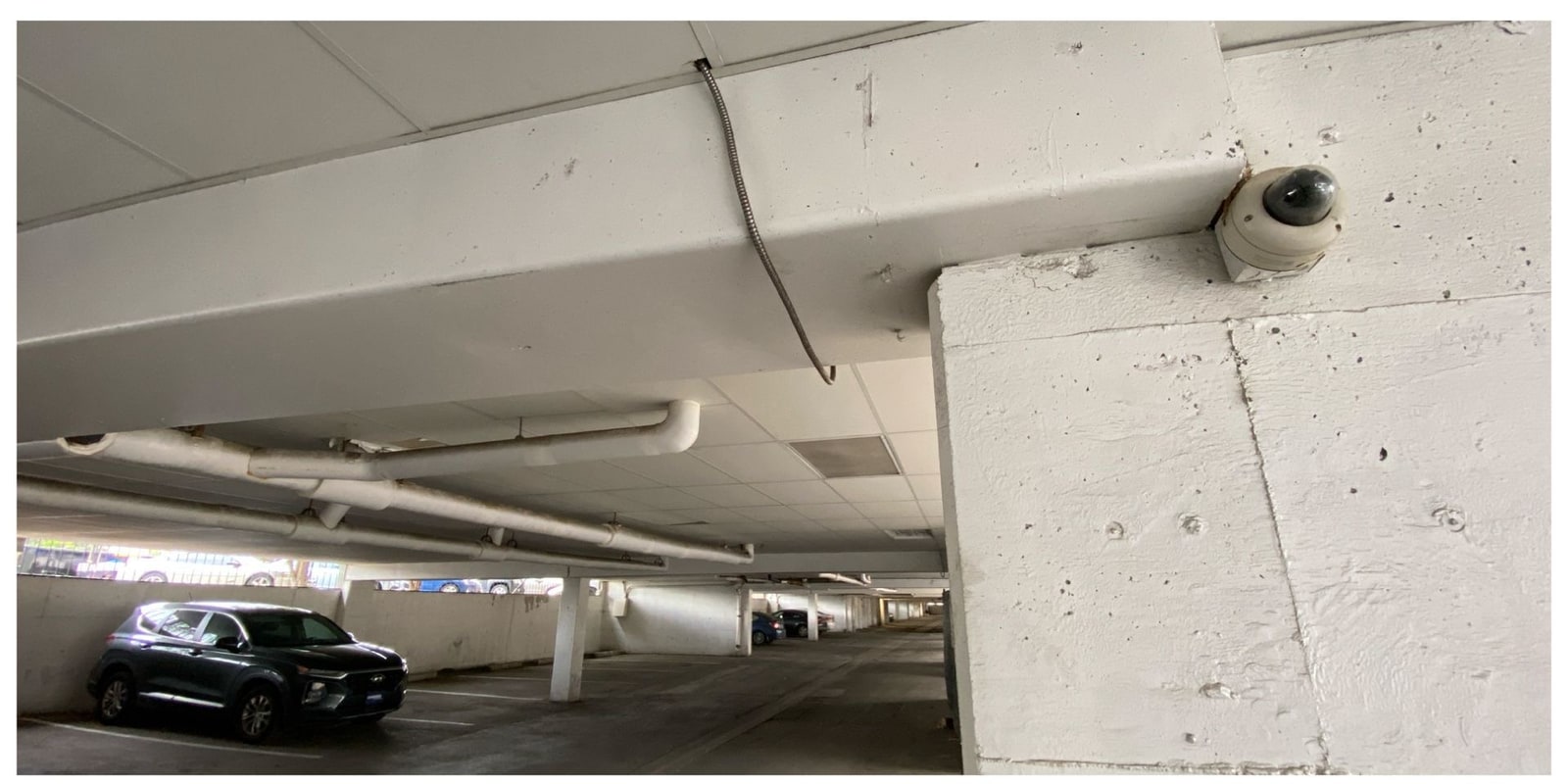
The installation The typical mount: a dome fixed to the concrete beam, aimed down the aisle rather than across the bays.
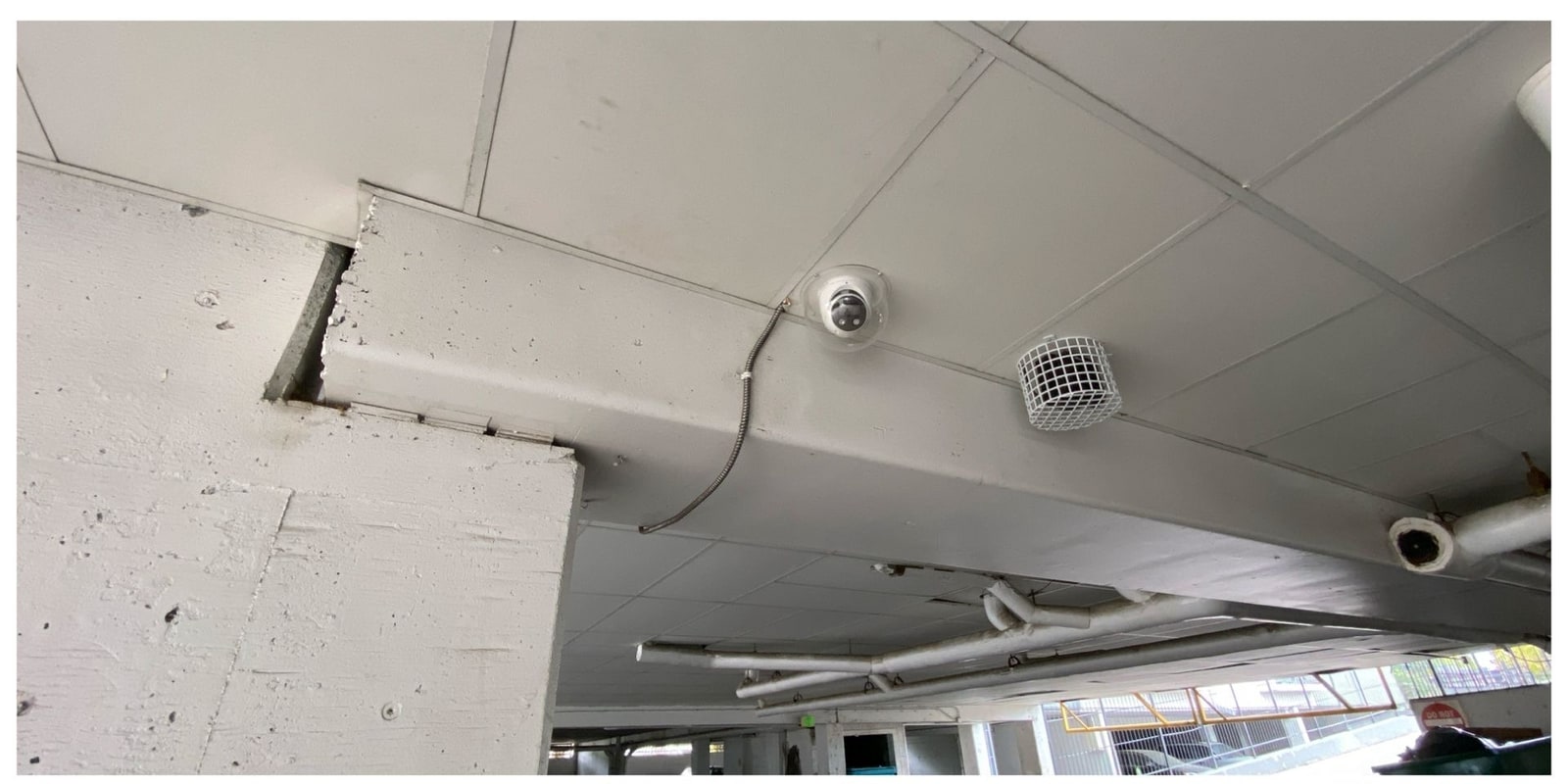
The installation Ceiling dome with its conduit run on the structure, beside a caged sensor — the wiring stays inspectable and out of reach.
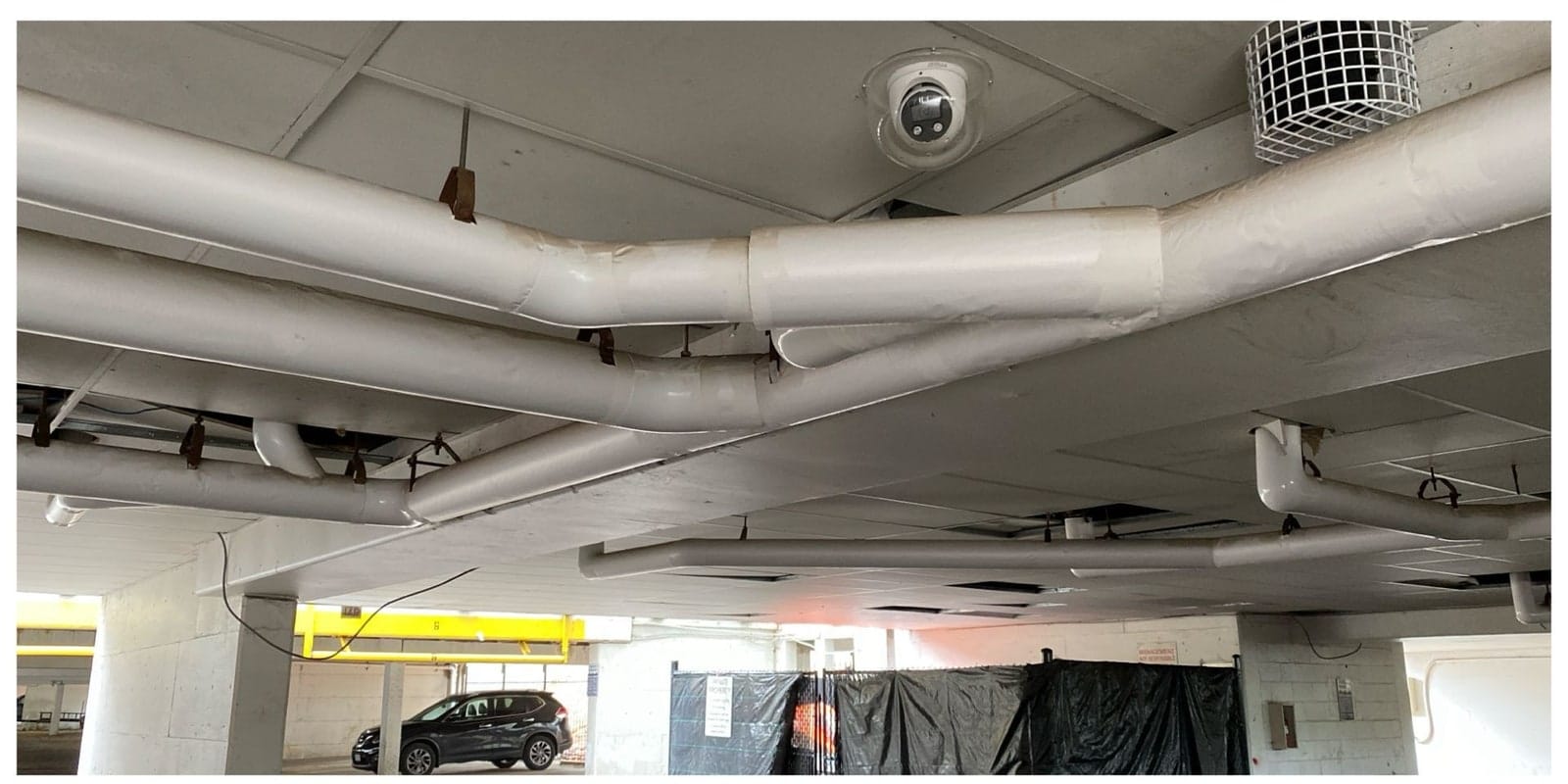
The installation Set into the ceiling among the sprinkler and drain runs, which is the only clear line of sight at the back of a deck.


1 of 3
Mounting to concrete, not to a wall
The deck ceilings are concrete beams and slabs with sprinkler and drain runs across them, and the low clearance rules out anything that hangs low. Each camera is fixed to the structure above the drive aisle and the parking bays, aimed down the deck rather than across it, so a camera sees the cars and the movement between them.
Height matters more than the housing here. A dome at beam height is above reach, out of the way of clearance bars and roof racks, and close enough to the openings to pick up daylight instead of relying on the darkest part of the deck.
- Dome cameras on the concrete soffits and beams, aimed along the aisles.
- Surface conduit routed on the structure, clear of vehicle clearance.
- Mounting heights chosen so the camera is not reachable from a parked car.
Conduit that survives the environment
A garage is hard on installation hardware: temperature swings, vehicle exhaust, pressure washing and standing water on the deck. The runs here are in protective conduit fixed to the structure rather than cable clipped to the slab, which is what keeps the wiring serviceable and out of reach of anyone who wants to interfere with it.
The same reasoning applies to the enclosures. Every connection is inside a box on the structure, not left as a gland in open air.
Coverage at the openings and the deep deck
The drive-in and drive-out openings are handled by the cameras nearest the ramp, and the back of the deck by the cameras further in. That split is deliberate: the openings are bright and busy, while the back of the deck is where a vehicle sits unobserved and where the light is worst.
The result is a deck where the aisle, the bays and the pedestrian route to the stairwell each have a view that covers them, rather than a single camera covering the middle third of the garage.
Related:Residential securityCommercial security camera systems
What it changed for the property
The property now has recorded coverage of the deck rather than of the entrance alone, and the footage is specific enough to answer the question a resident actually asks: what happened to the car. That is a different standard from a camera pointed at a door.
It is also an installation the maintenance team can live with: conduit on the structure, boxes where they can be reached, and nothing hanging into the clearance envelope of a vehicle.
Related:All projectsContact us