
- Client
- Tabor Center
- Location
- Denver, CO
- Scope
- Commercial security camera systems · Commercial security · Video management system (VMS)
A parking structure is one of the harder places to run video analytics. Cars move all day, pedestrians cross the frame in every direction, lighting changes between levels, and the concrete structure works against both wireless signal and new cable.
The Tabor Center work was specified around that reality: cameras chosen for low-light image quality and vandal resistance, detection rules written for vehicles and people, and a network arranged so a long building stays serviceable as it grows.
The installation
The photographs below are from the completed job. They show the camera positions and how each housing sits against the surface it was mounted to.
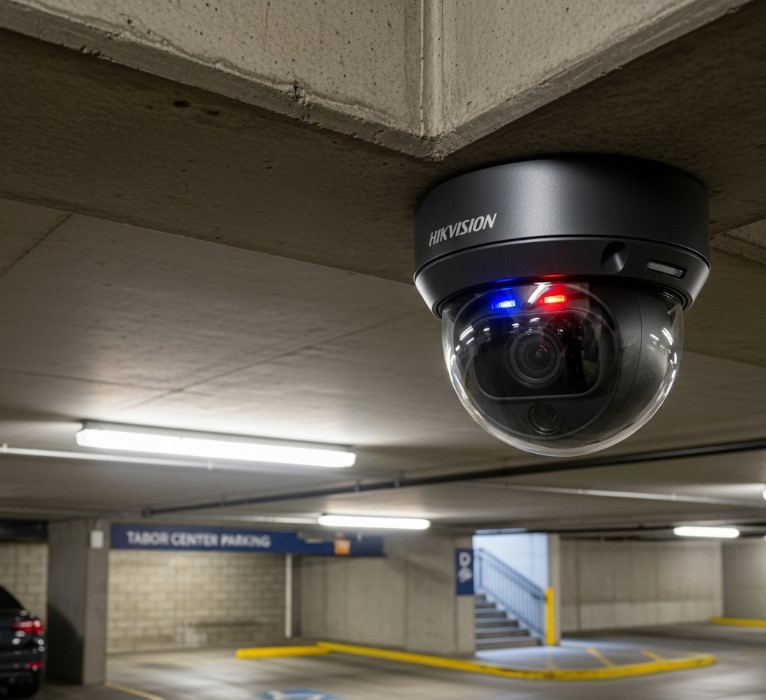
The installation An AcuSense dome above a parking level at Tabor Center, mounted to hold the ramp and the parking row in one view.

1 of 1
Where the security team was losing time
The garage is large, semi-public and always in use. The volume of vehicles and pedestrians is constant, so traditional motion detection produces alerts created by ordinary traffic rather than by anything worth investigating, and a team that receives those alerts learns to ignore them.
Coverage had to be dense enough that a camera is watching every ramp, elevator lobby and parking row, and selective enough that what it reports can be acted on. Those two requirements pull against each other on a budget, which is why the analytics carried as much of the design as the camera positions.
AcuSense cameras that report on vehicles
The camera specified for the garage was the Hikvision AcuSense dome network camera. Its value here is the filter: the camera is built to distinguish human and vehicle shapes, and it can raise an alert for a vehicle alarm rather than record another clip of a car passing through.
The dome housing matters in a public structure, where a camera on a pillar is within reach. Vandal-resistant domes mounted on ceilings and pillars hold a wide field of view and keep the hardware out of the way.
PoE+ power and a fiber ring
Each camera takes data and power over a single PoE+ connection from a switch, so no separate electrical circuit is needed above a parking deck. Cat6 runs feed those switches from the structured cabling path.
The distances across a structure of this size defeat copper. We used localized network switches joined by short fiber optic segments in overhead conduit, which creates network rings across the building instead of one long home run back to a single closet. Smart Codec on the cameras keeps the recording load in proportion to the bandwidth available.
Cable through an occupied concrete structure
The cable had to travel through occupied levels without closing them, so the runs follow existing conduit paths and overhead structure. The building is the obstacle: concrete attenuates wireless and offers no spare pathways.
The ring layout answers both problems. It shortens the copper, keeps the fiber in protected overhead conduit, and gives each level a local point of service rather than one fragile backbone.
What the garage runs now
Recording and analytics meet at the NVR storage and VMS servers, where the detection rules are configured and the alerts are reviewed. The security team has one place to look when something happens on any level.
The measure of the job is not the camera count. It is a garage where an alert means a vehicle or a person was detected in a defined area, and where the footage behind that alert has already been written down.
Related:All projectsContact us